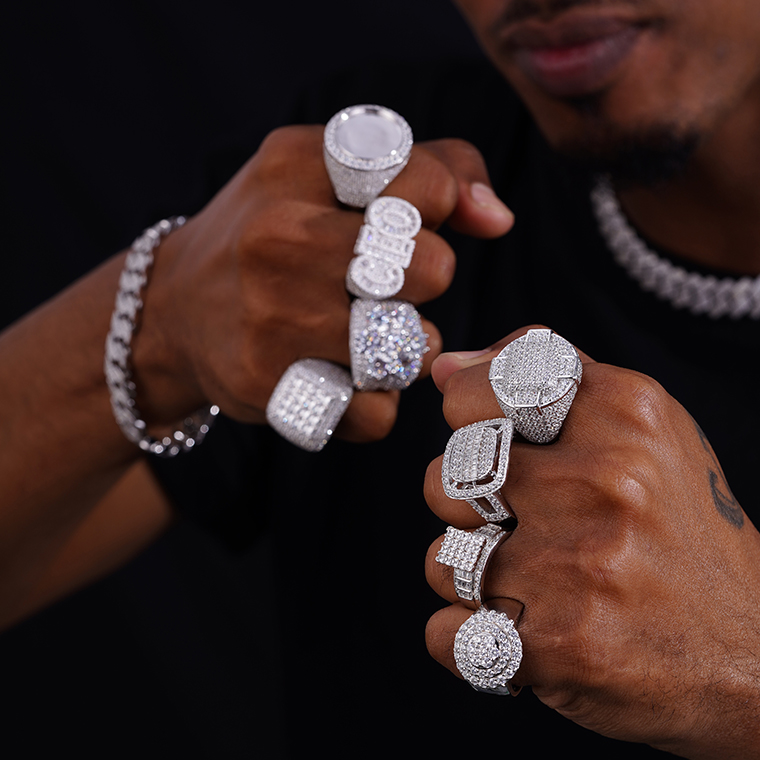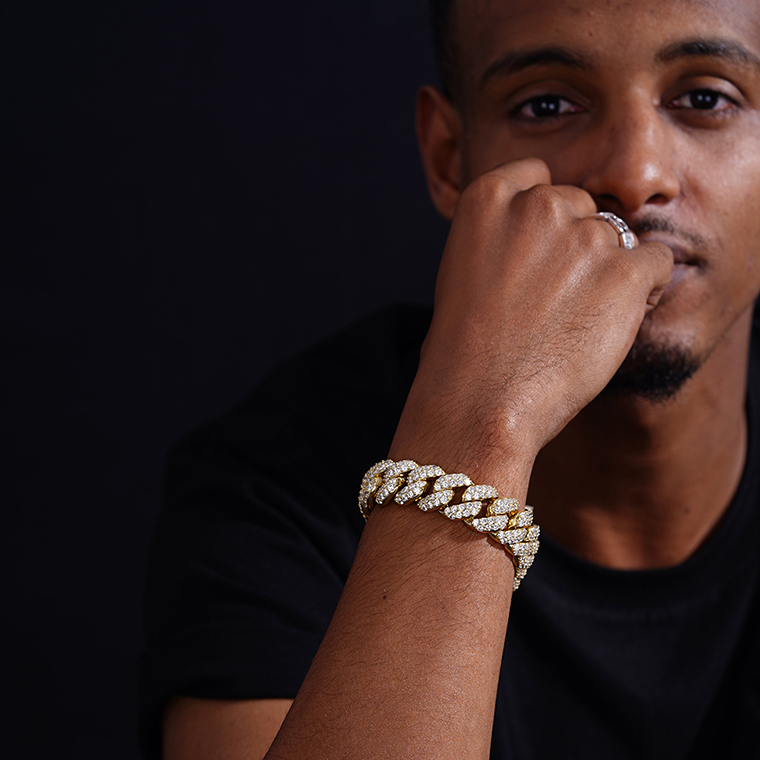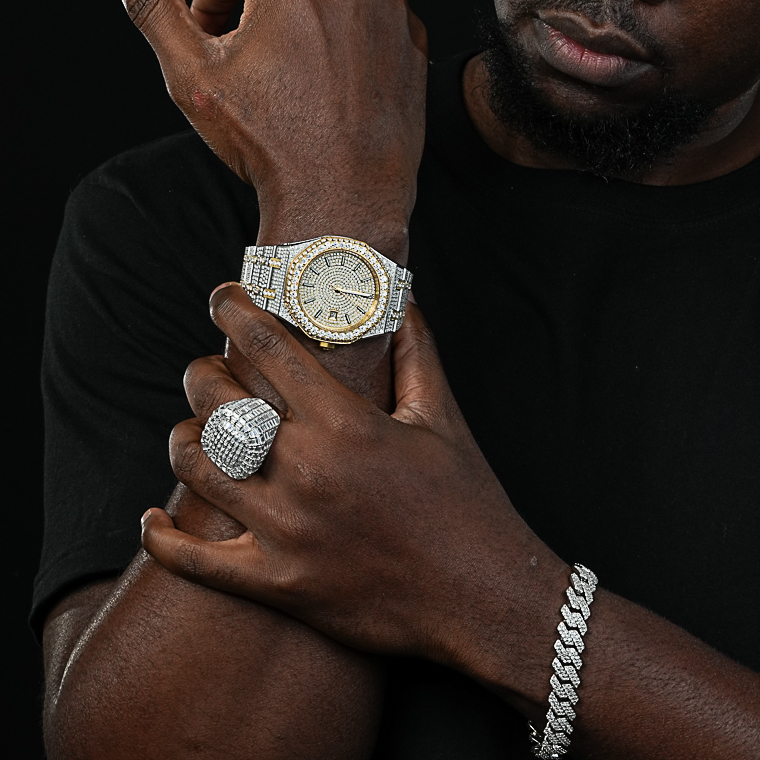






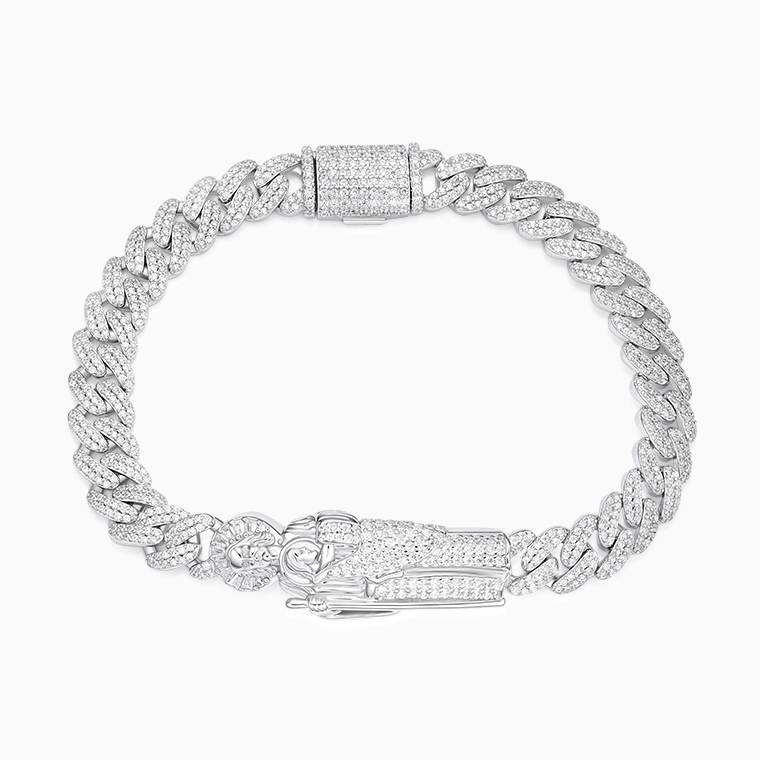

The opportunity is clear, but wholesale buying is not as simple as choosing the brightest chain in a supplier’s catalog.
Two pieces can look almost identical in photographs and still be very different products. One may contain more metal, better-matched stones, a stronger clasp, and a carefully finished back. The other may have thin plating, uneven settings, and a hollow construction that was never disclosed.
A successful order depends on understanding the whole piece—not only the stones on the front. Buyers need to consider the base metal, setting work, link construction, plating, sizing, weight, packaging, quality control, and the supplier’s ability to repeat the same standard later.
This moissanite hip hop jewelry wholesale guide explains how to choose products, prepare an order, evaluate suppliers, inspect production, and give customers realistic care advice.
What Is Moissanite Hip Hop Jewelry?
Moissanite is a laboratory-created gemstone known for its brilliance, durability, and strong fire—the flashes of colored light that appear when the stone moves.
In hip hop jewelry, it is commonly used in tennis chains, Cuban link chains, bracelets, pendants, rings, earrings, watches, and custom name or logo pieces. It works particularly well in iced-out designs because a manufacturer can use large stones or cover a wide surface without relying on the cost structure of natural diamonds.
Moissanite is not diamond. The two stones have different optical and physical properties, even if they can look similar to an untrained eye. Retailers should describe moissanite accurately and avoid wording that may lead customers to believe they are buying diamond jewelry.
Clear descriptions do more than reduce complaints. They also help a brand attract customers who are deliberately looking for moissanite because of its appearance, durability, and price position.
Why Buyers Choose Moissanite for Hip Hop Jewelry
Visual impact is one of the main reasons. A well-cut moissanite stone reflects light strongly and can look especially lively under retail spotlights, flash photography, LED lighting, and video.
That suits the way hip hop jewelry is often marketed. Customers want to see how a piece moves, how it catches light, and how it looks from a distance. Moissanite performs well in that environment.
It also gives designers more freedom. A large pendant may contain hundreds of small stones. A wide Cuban chain can require far more. With moissanite, brands can develop bold designs without moving directly into natural-diamond pricing.
Durability is another advantage, although it needs to be understood correctly. Moissanite is a hard gemstone, but the finished piece contains many other parts. Links can bend, clasps can wear, prongs can lift, and plating can fade. In daily use, these components may matter more than the hardness of the stone.
The category also covers several price levels. Brass can be used for accessible fashion pieces, sterling silver for mid-range collections, and solid gold for premium or custom work. The right choice depends on the customer, the intended retail price, and how often the jewelry is expected to be worn.
Moissanite, Cubic Zirconia, and Diamond
Wholesale buyers should understand the difference between moissanite, cubic zirconia, and diamond before comparing quotations.
Cubic zirconia, usually called CZ, is widely used in inexpensive fashion jewelry. It can look bright when new, but the surface may become scratched or cloudy after repeated exposure to skin oil, cosmetics, dust, and unsuitable cleaning products.
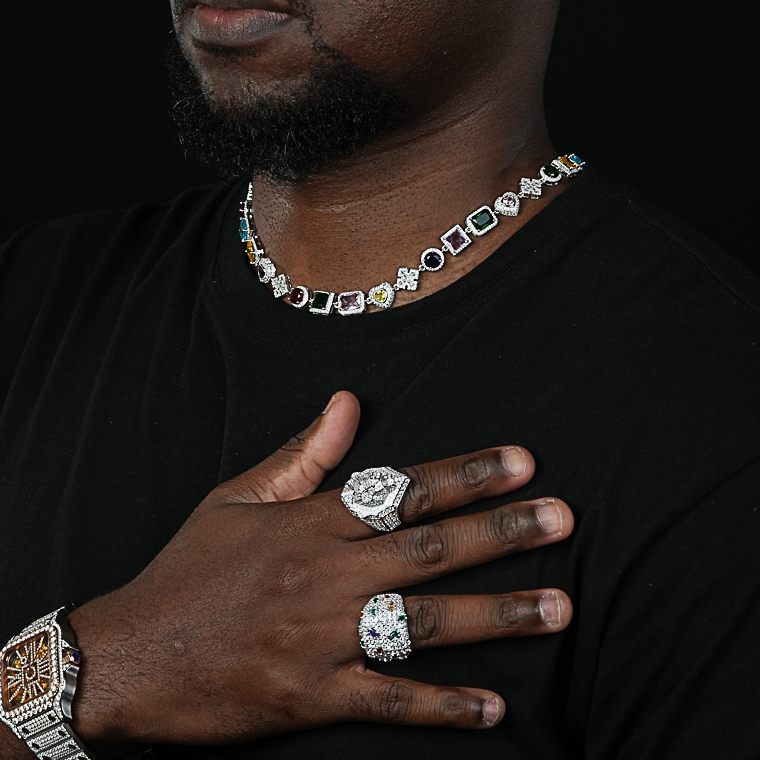
Moissanite is generally more durable and often has a livelier optical appearance. In most jewelry collections, it sits above CZ in price and customer perception. However, a moissanite stone does not automatically make the entire piece high quality. Weak settings and poor construction can still turn it into a disappointing product.
Diamond belongs to a different category with its own grading, pricing, and market expectations.
Buyers should also be careful when demonstrating stones with handheld diamond testers. Some thermal testers may react to moissanite because of the way it conducts heat. A positive reaction on that type of device does not prove that the stone is diamond.
Product pages and sales materials should state whether a piece contains moissanite, CZ, lab-grown diamonds, natural diamonds, or a combination of stones.
How to Judge Moissanite Quality
Suppliers often describe their stones as “VVS,” “D color,” “premium grade,” or “diamond quality.” These terms sound impressive, but they should not replace a physical inspection.
Look at color under more than one light
Colorless or near-colorless moissanite is usually preferred for white-metal hip hop jewelry. A sample should be viewed in daylight, warm indoor light, and cool LED light. A stone that looks neutral in one setting may show more warmth in another.Consistency is particularly important in iced-out jewelry. A small variation may be difficult to notice in one loose stone, but it becomes obvious when hundreds of stones sit next to each other.
Check for chips and cloudy areas
Most commercial moissanite used in jewelry should look clean to the unaided eye. Examine samples for dark marks, chips, scratches, damaged edges, or cloudy areas.On a fully set piece, pay attention to whether one section appears duller than the rest. The problem may come from the stone itself, the cutting, residue behind the setting, or the angle at which the stone was installed.
Cut affects the way the jewelry looks
A poorly cut stone may look flat even when its color and clarity are acceptable. Move the piece slowly rather than judging it from one fixed angle.The stones should respond to light in a reasonably consistent way. If several remain dark while those around them are bright, the row deserves a closer inspection.
Matching matters in pavé work
With pavé settings, the overall effect depends on the stones working together. Their diameters, outlines, color, and visual brightness should be reasonably consistent.Look at the jewelry from the side. Stones set at different heights are often easier to see from that angle. Crooked rows and uneven spacing also tend to appear around corners, lettering, and the edges of a pendant.
Certificates have limits
Some suppliers provide third-party reports for larger stones. Ask who issued the report, what it verifies, and whether it can be matched to the individual gemstone.Small accent stones are not always individually certified. In those cases, batch documentation and the supplier’s quality-control process may be more useful than a pile of generic cards.
A gemstone certificate does not verify the whole piece. It says nothing about the metal, plating, clasp, soldering, setting work, or finished weight.
Choosing the Base Metal
The base metal affects price, weight, comfort, durability, maintenance, and the way the product should be marketed.Sterling silver
925 sterling silver is widely used for moissanite tennis chains, pendants, rings, bracelets, and earrings. It provides a recognized precious-metal base while remaining more accessible than solid gold.Silver can tarnish when exposed to moisture, cosmetics, sulfur-containing substances, or unsuitable storage. Rhodium and other surface finishes may help preserve its appearance, but those coatings can also wear.
Confirm that the product is genuinely sterling silver and ask whether it carries an appropriate hallmark. If material testing is important for the destination market, discuss it before placing the order.
Brass
Brass is common in large fashion-oriented pieces because it can create a substantial look at a lower price. It works well for trend-led collections and customers who care more about size and appearance than precious-metal content.Its performance depends heavily on the plating. Once the finish wears, the underlying metal may become visible or react with moisture and perspiration. That does not mean brass jewelry cannot sell well, but its construction and care requirements should be explained honestly.
Stainless steel
Stainless steel is valued for strength and resistance to tarnishing. It can be a practical choice for simpler jewelry, although it is less suitable for some highly detailed stone-setting processes. As a result, the available designs may be more limited.Solid gold
Solid gold is appropriate for premium collections and high-value custom orders. The quotation should identify the karat, finished weight, accepted weight tolerance, stone details, clasp construction, and hallmark requirements.Solid gold, gold-filled, gold vermeil, and gold-plated jewelry are different products. These terms should never be used as though they mean the same thing.
Why Plating Matters
Yellow-gold, rose-gold, white, and black finishes can make the same design look completely different. Plating, however, is still a surface treatment.Wear normally appears first on ring edges, clasp surfaces, chain corners, raised details, and pendant backs. These areas experience the most friction.
Ask what the base metal is, how the piece is plated, whether a protective coating is used, and how the supplier checks color consistency. If plating thickness forms part of the product specification, request it in writing and ask how it is measured.
Be cautious with claims that plated jewelry will “never fade.” The life of a finish depends on plating quality, coating thickness, frequency of wear, climate, perspiration, cosmetics, cleaning habits, and storage.
How to Choose Styles for a Wholesale Collection
A useful collection does not need dozens of unrelated designs. It needs enough variety to serve different customers without locking too much money into untested stock.Tennis chains and bracelets
Tennis jewelry is a practical starting point because it crosses several style categories. It can appeal to hip hop customers, fashion buyers, and customers who prefer a cleaner look.Stone size is only one part of the product. Compare the chain length, width, total weight, flexibility, clasp, safety lock, and setting style.
Lay the sample flat. It should follow a smooth line rather than twisting at random points. Wear it for a while and see whether it flips. Open and close the clasp repeatedly. A chain can look excellent in a display tray and still feel awkward on the neck.
Cuban link chains
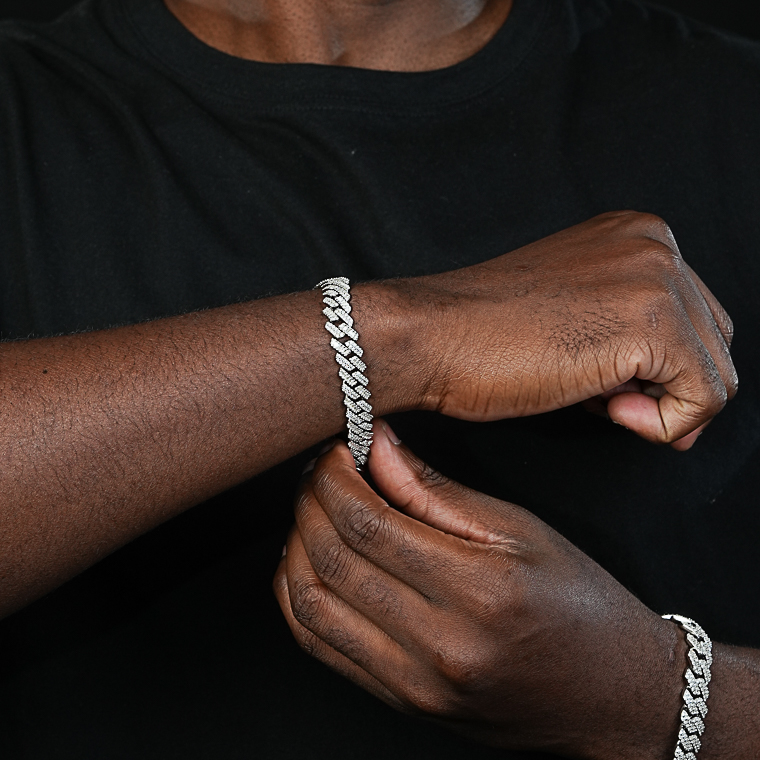
Cuban chains vary considerably in construction. Examine the link alignment, soldering, stone placement, edge finishing, and clasp strength.Ask whether the chain is solid, semi-hollow, or hollow. A wide chain is not necessarily a heavy one, and photographs cannot show the difference. Request the approximate finished weight and agree on an acceptable tolerance.
The chain should move naturally without feeling loose. If one section remains stiff or several links lift away from the neck, the construction may need adjustment.
Pendants
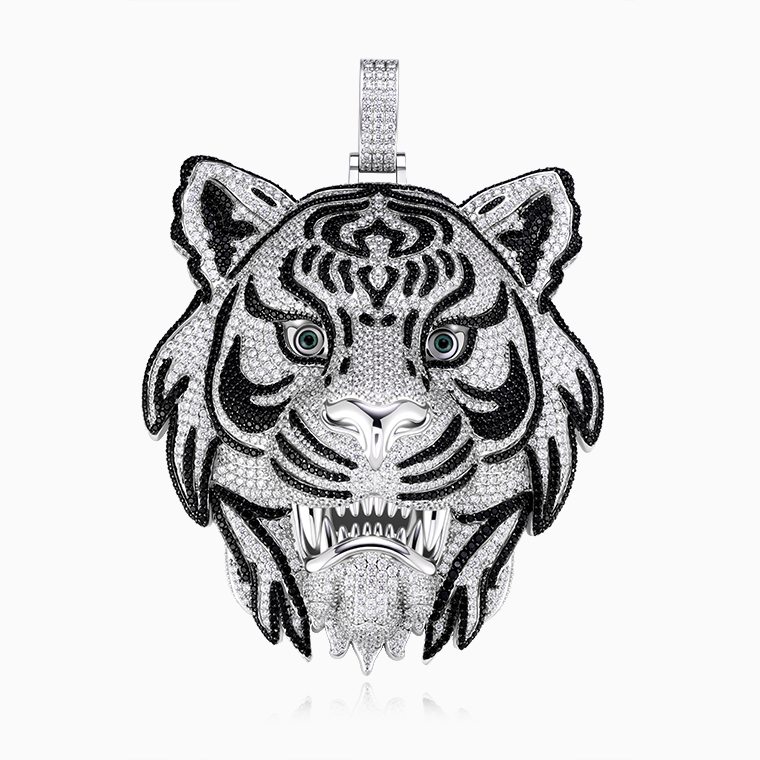
Pendants give a collection more personality. Crosses, initials, numbers, animals, symbols, and medallions can be sold as standard designs, while custom pieces serve artists, teams, clubs, and personal brands.The bail deserves careful attention. It must support the weight of the pendant and fit the intended chain. When measuring the opening, remember that the chain’s end cap may be wider than its links.
Turn the pendant over. A roughly finished back can catch on clothing and make the piece feel much cheaper than it appears from the front.
Rings
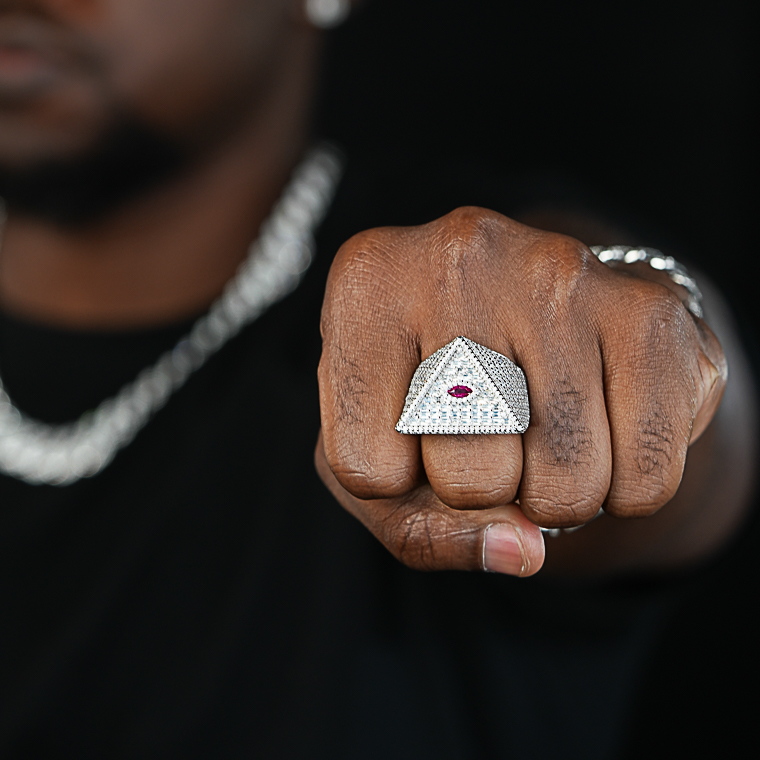
Confirm which sizing system the supplier uses. US, UK, European, and other ring sizes are not interchangeable.Wide bands often feel tighter than narrow rings marked with the same size. It is worth testing physical samples before ordering a complete size range.
Check the inside finish, comfort, prongs, stone security, and whether the design can be resized. Heavily set or plated rings are often difficult to alter without affecting the stones or surface color.
Earrings
Studs and small hoops offer an accessible entry point for customers who are not ready to buy a chain or pendant. They also work well as add-on purchases.Confirm the post material, backing style, pair weight, and stone security. Because earrings stay in close contact with the skin, accurate material and coating descriptions are especially important.
Custom name and logo pieces
Custom jewelry can produce higher order values, but it also creates more room for misunderstanding.Before production, confirm the spelling, capitalization, dimensions, font, stone layout, metal, plating, engraving, bail size, chain pairing, and packaging. Check names and dates one character at a time.
A CAD rendering is useful, but it does not answer every practical question. Very thin letters, narrow corners, and small gaps may behave differently once the design is turned into metal.
Do not reproduce another company’s trademark, logo, or protected character without appropriate authorization.
Building a Product Range That Can Sell
A balanced range usually includes several price levels.Small pendants, studs, narrow bracelets, and lightweight rings can bring customers into the category. Tennis chains, medium Cuban bracelets, and larger pendants may occupy the middle. Heavier silver pieces, detailed custom work, and solid-gold jewelry can serve the premium end.
It is also sensible to separate dependable designs from short-term trends. Initials, crosses, tennis chains, and classic Cuban links generally have broader appeal. A highly specific symbol or novelty pendant may sell quickly for a short period and then become difficult to move.
For a first order, buy more units of versatile designs and fewer units of experimental pieces. Once sales begin, customer behavior will show which lengths, sizes, colors, and price points deserve a larger reorder.
How to Place a Wholesale Order
Many sourcing disputes begin with a handful of reference photographs.
The buyer assumes the images show the required weight, dimensions, clasp, stones, and construction. The supplier sees them mainly as a design reference. Both sides say they understand, but they are not necessarily agreeing to the same product.
A written specification sheet is much safer.
Prepare one for every SKU. It should record the product name, model number, base metal, purity, plating, stone shape, stone size, dimensions, chain length, approximate weight, clasp, safety lock, engraving, logo position, packaging, labels, quantity, inspection method, and delivery terms.
If production variation is acceptable, write down the tolerance.
Terms such as “heavy quality,” “premium stones,” and “same as the picture” are too open to interpretation. Two 20-inch chains can look similar in a photograph while differing greatly in weight and feel.
For complicated products, add measurements directly to a drawing or image. Pendant height, bail opening, chain width, and logo position are easier to understand when they are marked visually.
Begin With a Physical Sample
Samples are not wasted money. They are the cheapest point at which a buyer can find a serious problem.
Whenever possible, the sample should use the same metal, plating, stones, setting method, clasp, and packaging planned for production. A silver prototype is not an accurate reference for a later brass version.
Ask whether the sample came from regular production or was specially prepared. A hand-finished piece made by a senior craftsperson may not represent the standard of a normal bulk run.
When the sample arrives, wear it. Open and close the clasp several times. Lay the chain flat. Check the back, edges, engraving, spaces between links, and areas around the bail.
Record the weight and dimensions. Photograph the piece in daylight and indoor light, including the less visible parts.
Once it is approved, identify it in writing as the production reference. There will still be minor manufacturing variation, so agree on acceptable tolerances rather than expecting every unit to be identical down to the last fraction of a millimeter.
Understand the MOQ
MOQ means minimum order quantity, but it may apply in different ways.A supplier might accept 50 pieces in total while requiring at least 10 units per design. Another may allow mixed designs but not mixed plating colors. Ring orders may carry a minimum for every size.
Ask how the MOQ applies to each design, color, size, and material. Otherwise, a low advertised MOQ can still leave the buyer holding too many units of slow-moving variations.
Smaller orders usually cost more per unit, but they reduce inventory risk. Larger orders may improve the price while tying up cash in products that have not yet proved themselves.
For a new collection, a controlled test order is often more useful than the lowest possible unit cost.
Read the Quotation Carefully
The quotation should show what is and is not included.
Ask about CAD work, molds, samples, engraving, certificates, branded boxes, labels, inspections, and freight. If an item is not listed, do not assume it is part of the price.
For custom jewelry, find out whether the mold fee is charged once or on every order. Clarify who owns the mold and design files and whether the supplier may sell the same design to other customers.
If exclusivity matters, document it clearly.
For precious-metal products, ask how the final cost will be calculated. A quote may use an estimated finished weight and then be adjusted after production. Agree on the accepted weight range and the method used to handle any difference.
Also record the currency, payment schedule, and quotation validity period. Metal prices, exchange rates, stone costs, and labor expenses can change.
Approve One Final Production Version
Designs often pass through several rounds of changes. There may be an early sketch, a revised CAD file, an updated quotation, and a long message thread containing new measurements.
Before production begins, bring the final details together in one approved version.
Confirm the SKU, quantity, size, dimensions, stone layout, metal, plating, engraving, packaging, and delivery arrangement. For custom pendants, check spelling, capitalization, punctuation, dates, and number sequences.
Make sure the bail fits the selected chain, including the end cap. Once manufacturing starts, a small change may require a new mold, additional stones, or extra handwork.
Inspect the Goods Before Shipment
An item can match the approved design and still have problems with assembly or finishing.Begin by confirming the quantity, SKU, size, length, and plating color. Then inspect for missing stones, uneven rows, scratches, rough edges, excess solder, unclear engraving, and inconsistent plating.
Test the clasps and safety locks. Check that tennis-chain links move freely and that Cuban links do not twist or lock. Examine the bail and its connection point on heavier pendants.
Weight can help reveal production changes. A significant difference between the approved sample and the finished units may indicate a change in wall thickness, link construction, or metal content.
For a small repeat order, an agreed internal inspection may be sufficient. For a large order or a new supplier, an independent pre-shipment inspection can add another level of control.
The inspection standard should be agreed upon before production, not after defects are found.
Look Closely at Pavé Work
Dense pavé is where average workmanship is easiest to spot. A pendant may look impressive in a short video, especially under strong lighting, yet still have stones sitting at different heights or rows drifting out of line near the edges.Small stones leave little room for error. Their sizes must match, the seats need to be cut accurately, and the setter has to secure each stone without damaging the surrounding metal.
The piece should be checked again after polishing and plating. Those later steps can loosen a stone that seemed secure when it first left the setting bench.
Do not judge this work from a front-facing product image alone. Ask for close photographs of the back, side walls, bail, and clasp. On a chain, look at the spaces between the links. On a pendant, check narrow corners and the point where the bail joins the body.
A short workshop video can be more useful than another polished catalog image. A slow video showing how the chain bends, how the clasp closes, and how the stones sit from the side can answer several questions at once.
There is another point worth raising: if the item sells, can the supplier make it again?
Repeat orders are not always identical to the first batch. The gold tone may shift, a clasp may be substituted, or the chain may arrive several grams lighter. This becomes a problem when the retailer’s photographs and descriptions are based on the original sample.
Before building a product page around a piece, find out which details the factory can reproduce consistently and which may vary.
A Supplier’s Answers Matter as Much as Its Samples
Supplier communication is often judged by speed. The content of the answer matters more.
Take finished weight as an example. “Around 80 grams” sounds specific, but the number may come from an actual chain, a CAD estimate, or the salesperson’s memory of a similar product. Those are different sources, and a careful representative should tell you which one applies.
The same issue appears after several design revisions. Perhaps the original pendant was 60 mm high, the second drawing reduced it to 55 mm, and the bail was enlarged in a later message. Unless the final details are gathered into one approved file, the workshop may begin from the wrong version.
Constant agreement is not necessarily reassuring. A salesperson who replies “yes, no problem” to every request may not have checked with the production team. Waiting for a measured answer is often preferable to receiving an immediate promise.
Pay attention to the questions the supplier asks as well. An experienced manufacturer may want to know which chain will pass through the bail, whether the pendant height includes the bail, or whether the quoted weight refers to the finished piece. Those questions may slow the conversation, but they often prevent errors.
Get the Material Description in Writing
“Moissanite jewelry” describes the stones. It does not identify the body of the piece.
A moissanite pendant may be made from sterling silver, brass, stainless steel, or solid gold. The products may look similar after plating, but their price, weight, maintenance, and customer expectations will be different.
The written order should name the base metal and finish separately. “925 sterling silver with yellow-gold plating” is clear. “18K gold,” by itself, is not. It could mean solid 18-karat gold or an 18K-colored plated finish.
The distinction should also appear in the retail description.
Read material reports instead of only checking that a laboratory logo is present. Look at the date, sample description, and tested items. A report for an old silver ring does not automatically verify a new production run of brass pendants.
Market requirements also vary. Rules involving nickel release, lead, cadmium, hallmarking, labeling, and children’s jewelry depend on where the products will be sold. The importer should confirm the relevant requirements before production.
Discuss Defects Before Ordering
It may feel awkward to discuss defective goods during a first negotiation. It is still easier than trying to create a policy after a shipment has arrived.
Ask how long the buyer has to report a problem and what evidence the supplier will need. Photographs may be enough for an obvious plating issue, while a loose clasp may be easier to show in a short video.
The remedy should suit the problem. A couple of loose accent stones may be handled with replacement stones or a local repair allowance. An entire shipment made in the wrong metal requires a different response.
Some suppliers prefer to replace faulty pieces in the next order. That can work in an established relationship, but it is less useful when the buyer has not decided whether another order will be placed.
A factory that admits minor defects can occur is not necessarily unreliable. Jewelry passes through casting, setting, polishing, plating, assembly, and packing, often with substantial handwork. What matters is how problems are detected and resolved.
The Lowest Quote May Not Be the Lowest Cost
When two chains look similar in photographs, choosing the cheaper one may seem obvious. The price difference, however, may come from the product itself.
One chain may contain less metal. Another may use thinner plating, fewer stones, a simpler clasp, or less protective packaging. These choices are not automatically wrong, but the buyer needs to see them before comparing prices.
Sampling, CAD work, molds, packaging, inspection, freight, insurance, import charges, payment fees, repairs, and returns all contribute to the cost of getting a saleable item into the customer’s hands.
Consistency also has financial value. If a repeat order arrives in a noticeably different gold tone, the retailer may need to reshoot product photographs or explain the difference to customers. A lighter second batch creates a similar problem when the website lists the weight of the original sample.
The lowest quotation can still be the right choice. It simply needs to represent the same material, construction, dimensions, weight, and service as the other offers.
How to Care for Moissanite Hip Hop Jewelry
Moissanite itself is not usually the difficult part of jewelry care. The setting, metal, plating, links, and clasp require more attention.
A chain worn close to the skin collects oil, perspiration, soap, and cosmetic residue. On an iced-out piece, much of that buildup settles behind the stones, where it blocks light. The jewelry may look dull even though the gemstones are undamaged.
For many pieces, lukewarm water, mild soap, and a soft brush are enough. Work gently around the settings and clean behind the stones. Rinse away the soap and dry the jewelry with a soft, lint-free cloth.
That method does not suit every construction. Enamel, blackened details, glued elements, and delicate plated finishes may need different treatment. Care advice should reflect the actual product rather than the stone alone.
Avoid chlorine, bleach, strong household cleaners, abrasive powders, and unsuitable jewelry dips. They may leave the moissanite intact while damaging the metal or surface finish.
Perfume, lotion, hairspray, and cosmetics are best applied before the jewelry is put on.
Daily Wear Places Stress on the Jewelry
A heavy chain moves constantly against the neck and clothing. Rings strike desks, doors, and bags. Pendants swing and pull against their bails.
Jewelry should be removed before swimming, showering, sleeping, exercising, or doing physical work. Water is not the only concern. Sweat, chemicals, friction, repeated bending, and accidental impact all increase wear.
Heavy pieces should be handled by the main body of the jewelry. Do not lift a large pendant by a narrow bail or swing a chain from its clasp.
Small changes should not be ignored. If a clasp closes differently, a chain begins to kink, or a stone moves under gentle pressure, stop wearing the piece until it can be checked. Early repairs are usually simpler than replacing a lost stone or pendant.
Store Pieces Separately
The main purpose of storage is to stop jewelry from rubbing against other pieces.
Use individual pouches, lined compartments, or fitted boxes. Fasten chains before storage to reduce tangling, and lay heavier pieces flat rather than forcing them into a small pouch.
Moissanite can scratch softer materials. At the same time, the metal edge of one chain may damage the plating on another. Keeping pieces apart protects both the stones and the finish.
Sterling silver may tarnish, particularly in humid conditions. Suitable anti-tarnish products can help, provided they are compatible with the other materials used on the piece.
Retail packaging should also hold the jewelry securely during transport. A heavy pendant sliding around inside an oversized box can arrive scratched even if it left the factory in good condition.
Explain Plating Honestly
Customers sometimes assume that because moissanite is durable, the color of the jewelry will also remain unchanged. These are separate issues.
A plated finish sits on top of the base metal. Friction gradually wears it, usually first on ring edges, clasps, raised links, and pendant backs. Sweat, cosmetics, and unsuitable cleaning can accelerate the process.
There is no universal answer to how long plating will last. A chain worn occasionally will age differently from one worn every day. Climate and individual skin chemistry can also affect the result.
Claims such as “never fades” create expectations that plated jewelry cannot reliably meet. A better description identifies the base metal, explains the finish, gives practical care advice, and states whether replating is available.
Common Wholesale Mistakes
Ordering directly from supplier photographs is one of the largest risks. Pictures can show the design, but they cannot show how the chain moves, whether the clasp feels secure, or how well the back has been polished.
Strong lighting can also disguise inconsistent stones and rough finishing. Even a small sample order provides information that photographs cannot.
Another mistake is placing too much confidence in a gemstone certificate. The report may describe the moissanite, but it does not confirm the metal content, plating, clasp, soldering, or overall construction.
Unclear specifications cause a different kind of problem. If the order only says “same as sample” or “high quality,” the buyer has little to refer to when production varies. Record the dimensions, finished weight, stone size, metal, plating, packaging, and accepted tolerances.
Large opening orders also deserve caution. A lower price per unit may look attractive, but the saving disappears if half the inventory remains unsold. Test new designs in smaller quantities, then use sales results to guide reorders.
Repairs are easy to overlook. For a repeat style, it may be helpful to obtain several matching loose stones or confirm that the supplier can provide them later.
Finally, keep the product description accurate. Moissanite is moissanite. Plated sterling silver is not solid gold. Straightforward descriptions may sound less dramatic, but they make it easier to build repeat business.
Final Thoughts
The front of a moissanite chain or pendant makes the first impression. The quieter details decide what happens after the sale.
Look at the clasp. Turn the pendant over. Check how the chain bends and whether the stones remain level near the edges. Ask where the quoted weight came from and whether the same construction can be reproduced in a later batch.
For a new design, begin with a physical sample and a manageable quantity. Keep proven styles in deeper stock, while treating more unusual pieces as market tests. Customer purchases will eventually provide better guidance than a supplier’s bestseller list.
This approach takes longer than choosing a catalog photograph and requesting the lowest price. It also produces fewer surprises. The retailer knows what has been ordered, the supplier has a clearer standard to follow, and the customer receives jewelry that matches its description.