






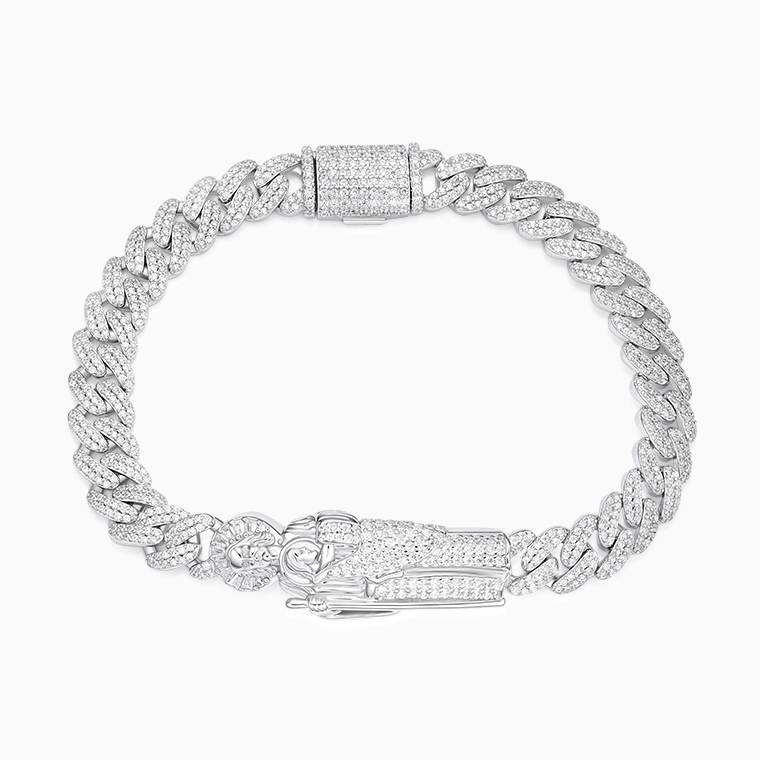


For jewelry retailers, available inventory can shorten the path to a sale. The commercial value depends on knowing exactly what is available, when it can leave the supplier, and whether it matches the product the customer expects.
A photograph of an iced-out chain can answer a retailer’s first question: Does this belong in my store? It cannot answer the questions that determine whether the purchase will work.
How many pieces are available in the required length? Does the quoted price cover brass or sterling silver? Are the stones moissanite or cubic zirconia? Can the supplier dispatch the entire order together?
Those details sit behind the appeal of ready-to-ship hip hop jewelry wholesale. Existing inventory gives buyers a way to add products without first commissioning a new design and sample. But a catalog selection becomes a usable purchasing plan only when specifications, quantities, and dispatch arrangements are confirmed.
For Shining Star Jewelry, which offers wholesale supply alongside design and manufacturing services, the discussion can extend beyond a single shipment. A buyer selecting available products today may later need replenishment, a modified version, or an original design. Establishing the terms of the initial order provides a foundation for that relationship.
Inventory Is Specific to a Product Version
The phrase “in stock” needs a precise object.
A supplier may have a particular Cuban chain design available, but that does not establish availability in every length, width, finish, and stone combination shown in its catalog. A photograph may represent several configurations, some available immediately and others requiring production.
Buyers should ask for availability against each selected item. A useful confirmation identifies the product code, material, stone type, dimensions, finish, quantity, and date of the stock check.
Consider an illustrative order containing three chain lengths in two finishes. Although the buyer has selected one design, the supplier must confirm six separate configurations. A shortage in one can affect the dispatch plan for the whole order.
The next question is whether confirmed stock will be reserved, and at what point. Buyers should establish whether allocation follows written confirmation, payment, or another agreed step. A quotation alone should not be treated as proof that the goods have been set aside.
A Minimum Order Is Only Part of the Purchasing Decision
Shining Star’s published wholesale policy gives a minimum order range of 20–30 pieces, depending on the product. It also states that pricing varies with quantity. Those terms provide a starting point, but buyers still need to confirm how they apply to a particular assortment.
The distinction matters for a retailer buying several categories at once. An order containing pendants, bracelets, and earrings raises different questions from an order of one necklace in a single finish.
Can the styles be combined? Does each color have its own minimum? Are ring sizes counted separately? Will a mixed order qualify for the same price as a larger quantity of one item?
These answers influence how much inventory the buyer must commit to.
A lower unit price may be attractive, but additional units still need to be sold. For an unfamiliar product, a narrowly selected assortment can provide more useful information than a large order assembled primarily to reach a discount threshold.
The purchasing objective should be explicit: replenishing an established seller, testing a new category, or preparing a coordinated collection. Each calls for a different allocation of stock.
Similar Photographs Can Conceal Different Specifications
Hip hop jewelry presents a particular challenge online: visually similar products can have materially different construction.
A gold-colored pendant may use brass or sterling silver beneath the finish. Two iced-out chains may differ in stone type, metal weight, clasp design, or dimensions while appearing comparable in a small image.
The order specification should separate these characteristics.
Base metal and surface finish belong in different fields. Stone type should be stated clearly. Length and width should use agreed units, and buyers should establish whether pendant dimensions include the bail.
For products sold as a set, confirm what the quoted package contains. A pendant photographed on a chain does not necessarily mean the chain is included.
This level of detail also helps the retailer prepare accurate listings. The same specification used to place the order should support the description customers see in the store.
Dispatch and Arrival Are Different Commitments
Ready inventory can remove some development and production steps. It does not eliminate payment processing, inspection, packing, carrier collection, or international transit.
A buyer planning a promotion therefore needs two separate pieces of information: the expected dispatch date and the estimated delivery window.
The dispatch commitment should identify its starting condition. Does the period begin after payment is received, after stock is reserved, or after packaging is approved? If the order contains both available stock and items awaiting production, will the supplier hold everything or arrange separate shipments?
Shining Star’s general wholesale policy also describes production lead times. Buyers placing a stock order should obtain confirmation of the schedule that applies to their selected goods rather than assume a general production timeline—or a promotional shipping statement—covers every purchase.
A small customization request can change that schedule. Different plating, an added engraving, or newly produced branded packaging may introduce work beyond picking and packing existing inventory. The supplier should identify that work before the buyer commits to a launch date.

Inspection Still Matters When the Product Already Exists
Stock availability answers a supply question. It does not settle whether the product meets the buyer’s requirements.
A first purchase may justify ordering a sample or requesting current photographs of the selected configuration. For a repeat purchase, the buyer should confirm that the item has not changed since the previous order.
The inspection priorities depend on the product. A chain needs attention to its clasp, link movement, finish, and stone alignment. A pendant needs a compatible bail and a clearly identified reverse construction. Earrings require matching pairs and the agreed posts and backs.
Manufacturing expertise becomes useful here. A supplier that understands how the piece is constructed can discuss a stiff connection, an unsuitable bail, or an unexpected difference in weight more precisely than a product photograph allows.
Shining Star’s published manufacturing information describes production and finished-product inspection capabilities. Buyers can use that discussion to establish which checks are relevant to their order and what evidence can be supplied before shipment.
Product Content Is Part of Launch Preparation
For an ecommerce seller, inventory sitting in a box is not yet a finished sales offer.
The listing still needs images, measurements, material descriptions, and information about what is included. If those materials are prepared only after delivery, part of the time gained through stock purchasing may be lost.
Shining Star can provide ecommerce product imagery, including white background and model-style images, as part of its product-content support. Buyers should confirm availability and usage arrangements for the selected items.
White background images help customers examine the design. Model images communicate scale and wearing position. Reverse, side, and detail views answer questions that a single promotional photograph leaves open.
The critical check is correspondence. The photographed finish, chain length, clasp, and stone configuration should match the version being sold. Where a model image is illustrative, the listing should make the actual product dimensions clear.
Plan for the Second Order Before Placing the First
A product that sells well creates a new purchasing question: Can it be replenished?
Existing inventory may be repeatable stock, a limited batch, or the remaining quantity of an older design. Buyers should ask which applies.
If replenishment requires production, establish the likely process, minimum quantity, and specifications that will govern it. Retain the original product code, photographs, measurements, and approved sample where available.
This is where wholesale supply and manufacturing can complement each other. An initial stock order allows the retailer to evaluate demand. A later production discussion can address the version and quantity that the business now needs. Availability and production terms still require confirmation for each order.
Before authorizing payment, the buyer should have a written record of the exact goods, quantity, price, stock status, packaging, dispatch arrangement, and procedure for reporting discrepancies.
For a retailer, that record gives “ready to ship” a practical meaning. It identifies the merchandise the business is buying, the conditions attached to its delivery, and the reference to use when it is time to order again.