






These are useful things to discover in a sample. But a clear brief can bring many of the questions into the design discussion earlier.
For brands working with a custom hip hop ring manufacturer, the starting specification should describe how the ring will be worn as well as how it should look. Face dimensions, finger size, band width, construction, and stone placement all contribute to the finished product.
At Shining Star Jewelry, our design and manufacturing capabilities help buyers develop those details from artwork, reference images, or existing design files. The first conversation is an opportunity to identify which features define the ring—and which still need to be worked out.
Give the Ring Face Actual Dimensions
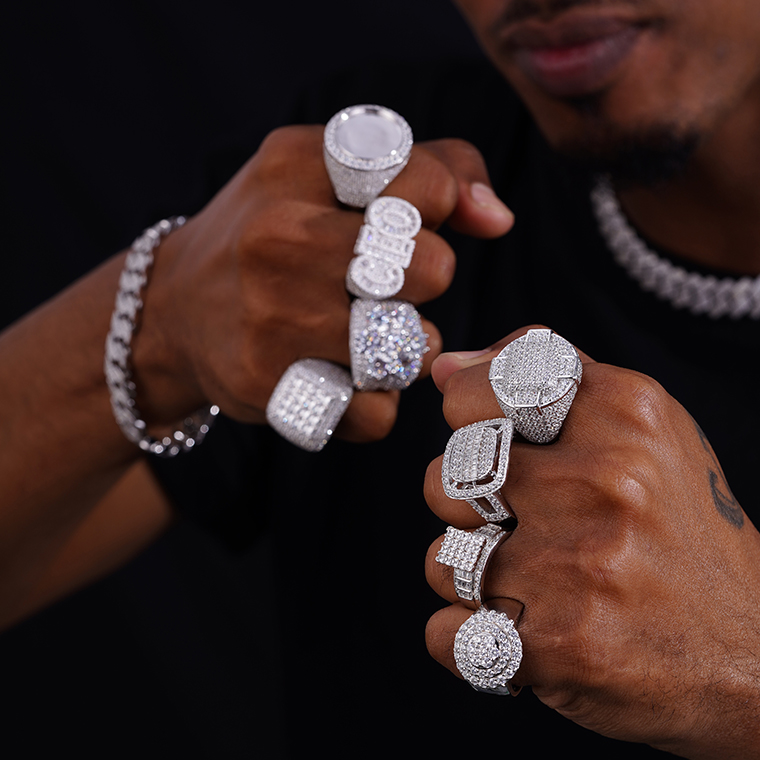
“Large” means different things to different buyers.One brand may want a broad, relatively flat face that carries its logo. Another may be developing a raised sculptural design with a strong side profile. Both could describe their reference as a large hip hop ring, even though the construction requirements differ.
Specify the approximate face width and length in millimeters. Also discuss how far the design should rise above the finger.
That third dimension can be easy to overlook. A front-view drawing shows the outline and decoration, but it says little about the height of a central motif or the transition from the face to the shoulders.
For a lettering design, identify the parts that must remain recognizable. Thin strokes, enclosed spaces, and closely positioned letters may need adjustment when translated into metal and stones.
Shining Star’s modeling capabilities include Rhino, Matrix, JewelCAD, and ZBrush. Depending on the project, these tools support measured jewelry construction or more sculptural development. Multiple views give the buyer a clearer basis for approval than a single presentation image.

A Ring Size Needs a Sizing System
A request for “size 9” leaves an important detail unresolved unless the sizing system is also identified.Tell the manufacturer which market and sizing convention the collection will use. Where possible, agree on a corresponding internal measurement and how the finished ring will be checked.
The measurement method matters because the interior shape and band width affect how a ring sits on sizing equipment and on the hand. Buyers should confirm the finished size after the relevant manufacturing and finishing stages, rather than relying only on the CAD dimensions.
For a wholesale collection, provide the intended size range at the beginning of development.
A design created around one size may need further review when extended to substantially smaller or larger versions. The factory and buyer must decide whether the face remains the same size, whether the shoulders change, and how the lower band accommodates the adjustment.
Those decisions help keep the collection visually consistent without assuming that every dimension should scale together.
Discuss Band Width Alongside Fit
The part of the ring beneath the finger deserves its own specification.A broad band creates a different wearing experience from a narrow one. Interior curvature, edge treatment, and the transition into the shoulders also contribute to how the ring feels.
A buyer who approves only the decorative face leaves these choices largely undefined.
Useful questions include:
- How wide should the band be at the bottom?
- Should that width remain consistent or taper toward the palm?
- What interior profile is intended?
- How should the inner edges be finished?
- How much space should remain around adjacent fingers?
If comfort is a central selling point, make it part of the sample review. Avoid approving the product solely from photographs.
Separate Visual Bulk from Metal Thickness
A substantial-looking ring does not necessarily have a uniform thickness throughout its body.The face, shoulders, lower band, and stone-setting areas perform different functions. Their dimensions should be considered individually.
A thick-looking top may use a recessed underside. A raised motif may need support at its connection points. A narrow band beneath a heavy face may affect how the ring balances on the finger.
This makes “make it heavier” or “make it lighter” incomplete revision instructions.
Identify the reason for the change. Is the sample too expensive at the intended material weight? Does the ring feel unbalanced? Is the underside difficult to finish? Does the buyer want a more substantial feel when customers handle it?
At Shining Star, these questions can be discussed alongside the model so that weight adjustments have a defined purpose. Removing metal from one area may preserve the appearance, while changing another could affect support or fit.
There is no single thickness specification that suits every custom hip hop ring. The appropriate construction depends on the design, material, dimensions, and setting requirements.
Leave Enough Room for the Stone Layout
An iced-out face needs a stone arrangement that works within the actual shape of the ring.Straight rows may suit a rectangular top. Curved lettering, raised borders, and sculptural surfaces introduce different constraints. The available space also changes where the face turns toward the shoulders.
Before sampling, clarify which areas should carry stones and which should remain polished, engraved, or otherwise finished.
For a logo ring, complete stone coverage may compete with legibility. An unbroken metal border or a polished section can help preserve the original outline.
The design review should also consider the relationship between stone seats and surrounding metal. Crowding additional stones into a narrow area can create difficulties that become apparent during setting or finishing.
Buyers do not need to determine every technical detail themselves. They should, however, give the manufacturer a clear visual priority and ask to review how the proposed layout supports it.
Specify the Underside of the Ring Face
The underside is rarely the main product photograph, but it affects weight, finishing access, and the surface closest to the wearer.Ask whether the proposed construction uses a closed back, an open area, or recessed sections. Review the edges and connections visible from below.
A recessed design can include corners and openings that deserve closer examination in the sample. The buyer should check that the finish is suitable and that the ring does not have uncomfortable contact points.
This is also where a physical model can help explain the design before a finished sample is available.
Shining Star’s in-house wax printing capability gives the development team a physical form to examine. It supports evaluation of proportions and structure, while the finished metal sample remains necessary for assessing weight, surface quality, and fit.
Make the Material and Finish Unambiguous
The quotation and sample request should identify the base metal, stone type, and intended surface finish separately.For example, a gold-colored ring could have a brass or sterling silver base. Its appearance alone does not communicate that distinction.
Shining Star works with brass and 925 sterling silver, with moissanite and cubic zirconia options for suitable projects. The selection should follow the collection’s product positioning and agreed budget.
For a ring offered in several finishes, provide a reference for each version. Also identify areas that should be polished, matte, or treated differently.
Engraving needs its own location and size discussion. A brand mark inside the band must fit the available surface without interfering with other agreed markings.
Recording these details before sampling gives the buyer a more useful product to evaluate.
Approve the Ring as Something Customers Will Wear
When the sample arrives, compare it with the approved specification, then examine it on the hand.Check the face dimensions and overall profile. Look at the transition into the shoulders. Inspect the underside, interior edges, stone arrangement, and engraving.
Pay attention to whether the ring rotates, restricts normal finger movement, or feels awkward beside neighboring fingers. Feedback should describe the observed issue rather than jump immediately to a presumed solution.
“The shoulder presses against the next finger” is useful information. The design team can then evaluate whether the profile, width, or another detail needs to change.
After revisions, record the approved version and the specifications that apply to it. If the collection includes multiple sizes, agree on how the remaining sizes will be verified before the full order proceeds.
To discuss a custom ring with Shining Star Jewelry, send the artwork or reference images, intended face dimensions, sizing system, size range, preferred materials, and estimated quantity. Include any requirements for weight, engraving, or surface finish.
A precise brief gives the first sample a clear job: to demonstrate that the design works as a finished ring.