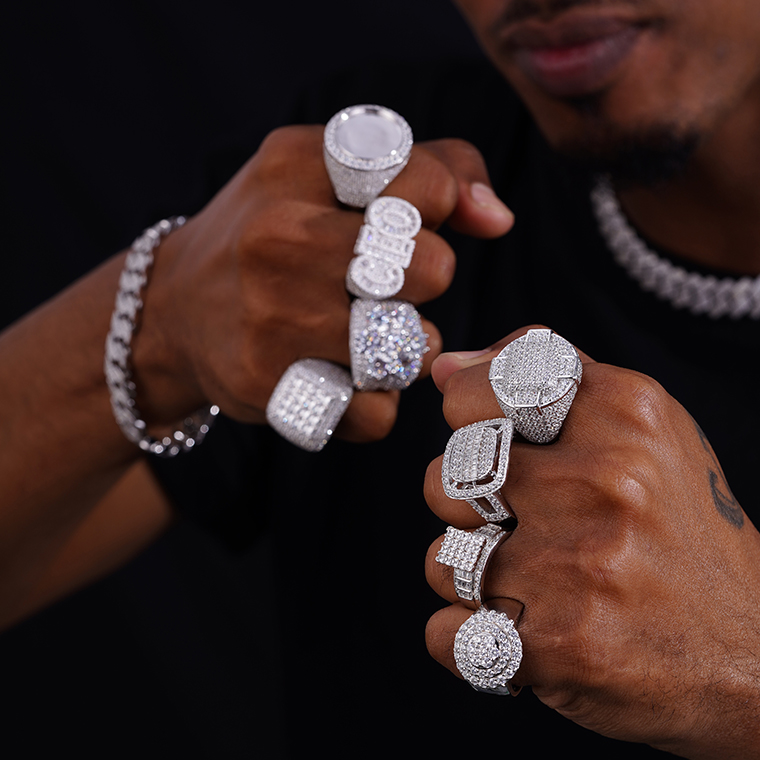






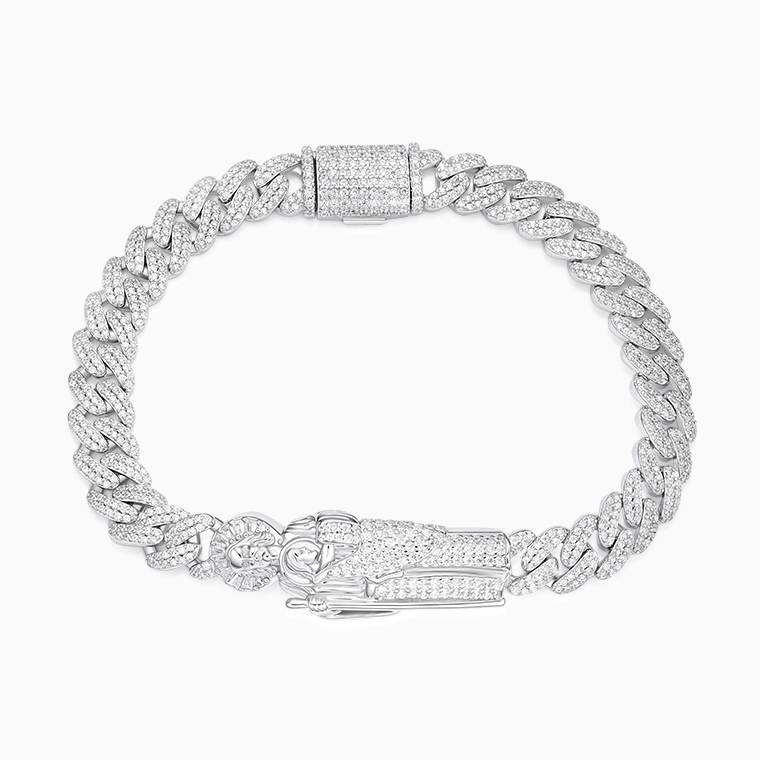
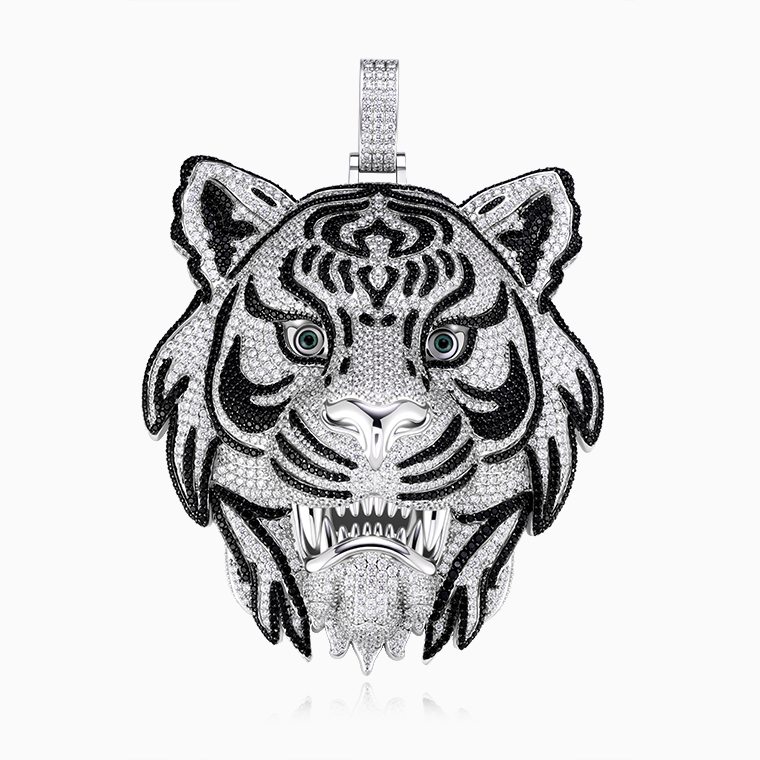

GUANGZHOU — A consumer looking at a stone-covered Cuban chain sees shine, scale and attitude. A wholesale buyer sees a much longer list: silver weight, stone security, plating consistency, production timing, reorder risk and the margin that remains after all of them are accounted for.
That widening gap between appearance and execution is reshaping the business of 925 sterling silver hip hop jewelry wholesale.
For years, hip hop jewelry occupied an unusual position in the accessories market. Its visual language came from luxury—large pendants, heavy chains, pavé surfaces and high-contrast finishes—while much of its commercial growth depended on accessible materials and rapid trend cycles. Sterling silver is now helping more brands move the category into a higher-value tier, but it also exposes weaknesses that lower-cost fashion jewelry can sometimes hide.
A sterling-silver piece must justify its material cost. It must preserve the bold look customers expect without becoming impractically heavy. It must survive scrutiny over metal content, stone setting and plating. And when a retailer reorders a successful design months later, the second shipment needs to look and perform like the first.
The result is a market in which design, manufacturing and wholesale service can no longer operate as separate functions.

High Silver Prices Are Changing the Product Equation
The first pressure comes from the metal itself.The Silver Institute’s World Silver Survey 2026 (https://silverinstitute.org/wp-content/uploads/2026/04/World-Silver-Survey-2026.pdf) reported that global silver-jewelry fabrication fell 8% in 2025 as record prices and volatility weighed on affordability. North America and Europe both declined. China, however, recorded a 5% increase, supported in part by substitution away from gold and by product innovation.
This is not a simple story of rising or falling demand. It is a story of segmentation.
Sterling silver is becoming more expensive to treat as a generic fashion-jewelry input, yet it remains an important bridge between base-metal accessories and fine jewelry. That makes it especially relevant for hip hop jewelry brands trying to offer precious-metal credibility without moving into solid-gold price territory.
For wholesale buyers, the trade-offs are becoming more technical. A larger pendant creates impact but raises metal cost. A thinner back can reduce weight but may weaken the structure or alter how the piece hangs. Dense stone coverage can increase perceived value while adding setting labor and potential after-sales risk. A premium clasp may improve both security and presentation, but it changes the target cost again.
When silver was cheaper, some of these decisions could be absorbed. At higher prices, they must be designed.
This shift favors factories that can discuss construction before issuing a final quotation. A useful supplier should be able to explain how dimensions, gram weight, stone layout, backing design, chain width and plating specifications affect both cost and durability. The commercial task is no longer merely to reproduce a reference image. It is to preserve the idea behind that image while engineering a product that can be manufactured, sold and reordered.
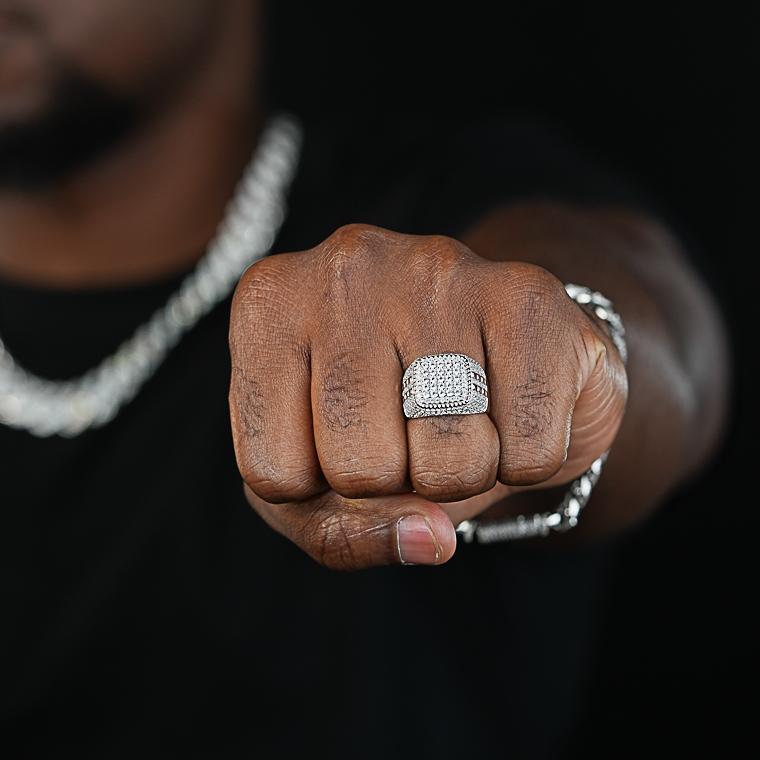
The Next Competitive Battleground Is the CAD File
Hip hop jewelry is visually extravagant but mechanically unforgiving.Turning a flat logo into a pendant requires decisions about thickness, balance, bail orientation, rear construction and stone placement. Character pieces introduce facial depth, fragile projections and polishing access. Cuban and tennis chains must combine flexibility with alignment, clasp strength and a continuous visual rhythm across dozens of moving components.
Small mistakes made in a rendering can become expensive after molding, casting and setting. A stone seat that looks acceptable on screen may be too shallow in metal. A bail may be visually proportional but too narrow for the intended chain. A hollowed section may save silver while creating a weak point during polishing or wear.
This is why custom jewelry production is moving upstream. More of the manufacturing work now happens before the first piece of metal is cast. CAD review, three-dimensional visualization and wax-model inspection allow brands and factories to resolve proportion and construction while changes are still relatively inexpensive.
Shining Star Jewelry, also known as Guangzhou Shining Star Jewelry Co., Ltd., offers one example of this more integrated model. According to company materials, its product-development operation includes more than 20 domestic and international designers using ZBrush, JewelCAD, Rhino and Matrix. The team can provide CAD, STL and 3DM files and develops roughly 400 new designs a month.
The company also prints wax models in-house. That matters for two reasons. It shortens the feedback loop between designer and production technician, and it reduces the need to circulate exclusive customer designs through an outside wax-printing vendor. For private-label brands, design confidentiality is not an abstract legal question; it is also a matter of how many external hands and systems a file must pass through before production.
The value of this setup is not the design count alone. It gives a wholesale customer two different forms of speed: the ability to assemble a collection from existing designs, and the ability to convert a logo, sketch or reference image into a manufacturable custom product. Brands driven by social-media releases and short merchandising windows increasingly need both.
A “925” Stamp Is No Longer Enough
Sterling silver is defined by its metal content: at least 92.5% silver. In cross-border wholesale, however, the practical question is not what 925 means. It is whether each production batch meets the agreed standard—and whether a supplier can show how it knows.Metal purity is only the first checkpoint. Iced-out jewelry creates additional failure points. Stones can loosen. Prongs can catch or deform. Chain links can bind. Clasps can fail under tension. Plating can vary between exposed and recessed surfaces. Aggressive polishing can soften the very details that made a design distinctive.
The industry response is a gradual move from final inspection toward a chain of evidence across production.
Shining Star says its silver is checked at three stages: raw material before production, random sampling after casting, and third-party finished-product testing when requested by the customer. Its listed in-house equipment includes a material-composition analyzer, salt-spray corrosion chamber, tensile tester, stone-setting security tester and plating-thickness instrument. The plating instrument can measure multiple points and generate an inspection report.
Individually, these are factory tools. Taken together, they address a more important buyer question: if a product falls outside specification, can the supplier identify where the variation entered the process?
The company’s internal management system tracks designs and orders from development through production and shipment. The system records details such as the assigned designer, design status and whether a mold has been opened. Administrative software rarely appears in a jewelry campaign, but for a wholesale customer it can have a direct effect on missed revisions, delayed orders and repeatability.
This is where manufacturing capacity begins to turn into wholesale reliability. A factory does not become dependable simply because it owns equipment. Reliability comes from connecting specifications, production checkpoints, test results and order records in a process that can be repeated.
Plating Has Become a Margin Decision
Plating was once treated as a late-stage cosmetic choice. In sterling silver hip hop jewelry, it is increasingly part of the product strategy.The same Cuban chain can be positioned differently in rhodium tone, yellow gold, rose gold or a two-tone finish. Plating influences color consistency, wear expectations, repair options and the claims a retailer can responsibly make to customers. As online shoppers ask how long a finish will last, brands must understand the difference between a color request and a measurable plating specification.
Shining Star established a plating factory in 2026, according to its company profile. Bringing that stage closer to design, production and testing can shorten the feedback loop for color matching, localized thickness measurement and corrective work. It can also help a wholesaler manage one of the category’s persistent problems: visible differences between an initial order and a later replenishment batch.
Vertical integration, however, is not a durability guarantee. The meaningful question is whether the approved finish, thickness requirement, test method and acceptance criteria are recorded and consistently applied. For buyers, “gold plated” is a description, not a complete specification.
Wholesale Buyers Are Redefining a Reliable Supplier
The future of wholesale jewelry may be shaped less by a small number of enormous orders than by a larger number of targeted product decisions.An emerging brand may want to test a tightly edited first collection. An established online retailer may reorder only the widths and lengths supported by sales data. A designer label may prioritize exclusive files and distinctive construction. A regional distributor may need a particular mix of colors, stone options and price points for its local market.
That changes the supplier-selection checklist. Price remains important, particularly when silver is volatile, but it is no longer sufficient. Buyers should ask:
- How and when is silver content tested?
- Can the supplier provide a reviewable 3D model before tooling or production?
- Which checks are used for stones, clasps, chain links and plating?
- How are revisions, approvals and order status recorded?
- Can a quality issue be traced to a batch and production stage?
- Which statements are supported by current certificates or product-specific reports?
Shining Star’s company presentation displays certifications and compliance marks including SGS, Intertek, REACH, Sedex, BSCI, ISO 9001:2015 and RoHS. A professional buyer should still verify the named entity, validity period, scope and relevance of each document to the specific goods being purchased. That is not distrust; it is modern procurement discipline.
From “Hit-Product Factory” to Product-System Partner
Hip hop jewelry will always respond to culture. Musicians, athletes, game characters, local symbols and social-media aesthetics will continue to inspire the next wave of pendants and chains. But a durable manufacturing business cannot depend on predicting every viral design.The more valuable opportunity is to help brands build a product system: which chain widths define entry, core and premium tiers; which pendant sizes read well on a mobile screen; how CZ and moissanite separate price levels; which constructions are suitable for repeat orders; and which intricate pieces are better treated as limited releases.
This is where factories can move beyond anonymous production. When a supplier participates early in weight, structure, stone and finish decisions, it helps the buyer manage margin before the product reaches the sample table.
Founded in 2015, Shining Star has developed an integrated design, production and sales operation. Company materials list a workforce of more than 125 people, a factory of approximately 1,850 square meters and distribution to more than 110 countries and regions. North America and Europe are its principal markets.
No single figure explains its position. The more relevant story is the combination: continuous product development, in-house CAD and wax printing, material and process testing, digital order tracking, and a closer link between manufacturing and plating.
For a buyer seeking a 925 sterling silver hip hop jewelry manufacturer or wholesale partner, that combination deserves more attention than a low quote viewed in isolation. Silver prices will change. Aesthetic trends will change faster. The scarce capability is the ability to translate a design idea into a product that can be approved, produced and reordered with confidence.
Hip hop jewelry has always been designed to be seen. Its supply chain is now being asked to become visible as well—from metal content and digital files to test results and production records.
That may be the most important change in the industry’s next phase.